Showing posts with label kayak fishing. Show all posts

Friday, May 15, 2015

Estero Kayak Challenge - 3 weeks away!

Update 5/15 - We are getting a great turnout as we get closer to the event, 44 anglers competing! There is still time to register if you haven't yet. Remember, there is no day of registration and we are 3 weeks away, so get those entries in. I would love to see us hit 50 anglers, can we do it? 

Even if you don't fish in the event, come out for some fun in beautiful Cayucos, Ca and help us celebrate the new Central Coast Chapter of Heroes on the Water!

1. Erik Nakamura - shogunofthecity
2. George Jercich - iZod
3. Ryan Howell - RHYAK
4. Eli Campos
5. Andy O'Brien - Dogpound
6. Billy Hurst
7. Bob Joslin
8. Kenny Nakamura - KennyKayak
9. Jeff Hopp
10. Eric Tebbets - Surfbrewer
11. Chad Britton - LOpaddler
12. Alan Kupstas
13. John Calvert
14. Robert Marlow - Squawfish
15. William Platte
16. Jesse Poquette - allwet
17. Phil Lopez - Lopezcador
18. Mike Watt
19. Jason Potts
20. Brian Nakamura - Nakatack
21. Kenny Wimer
22. Roy Arnold - Sideroad
23. Bill DuMong - Billydog
24. Nick Lana - Madcat
25. Chad Johnson
26. Justin Vermillion - J_Verm
27. Rendall Reidel
28. Gary Valerio
29. Barton Riggs
30. James Gosciminski
31. Eddie Falch
32. Jeffrey Veteto
33. Dustin McAdon
34. Carney Stuart-Williams
35. John Gonzalez
36. Michael Sapp
37. Corey Hamblin - Cor-Dawg
38. Ricardo Holden - Fisheye Channel
39. Rolland Felton - rfelton
40. Josh Knoll - CenCal-HOW
41. Daniel Mark Fleming
42. Carlos Cantu
43. Scott Kopp - FlyYaker
44. Brian Valenzuela

Thursday, April 2, 2015

Chasing Lingcod From a Kayak

Central California’s Coast, which for the purposes of ocean fishing, runs from Point Conception near Santa Barbara in the South up to Pigeon Point, near Santa Cruz in the North. This incredible and fishy stretch of coastline includes the areas of picturesque San Luis Obispo County, the beautiful and historic Big Sur region, the pristine Monterey Bay, and the rugged Santa Cruz coast. It is a paradise for anglers and outdoor enthusiasts of all types. Annually, at the New Year, the majority of saltwater fishing along this coastline closes and generally re-opens around May 1. This closure affects boat-based anglers, which includes kayak fishermen. For the first four months of every year saltwater aficionados are left counting down the days until the “groundfish” season returns. For 2015, the California Department of Fish and Wildlife has opened the rockfish (groundfish) season a month early, on April 1. For salt addicts like myself, this is welcome news and means that I will soon be back chasing one of my favorite fish to target, the toothy and aggressive Lingcod.

A toothy Central Coast lingcod.

Species and Habitat


The Lingcod (Ophiodon elongatus) is neither a Ling nor a Cod, but is a member of the Greenling family. They are found all along the west coast from the gulf of Alaska to Baja California. The biggest females of the species can grow up to 5 feet in length and weigh in at nearly 100 pounds! While large ling’s have been caught all along the West Coast, the California state record is 56 pounds, the Northwest and Alaskan waters tend to produce the larger specimens. Lingcod feed throughout the water column and I have certainly caught them at all levels, even on the surface. But, they are primarily bottom dwellers, being found in 30 to 300 feet (9 to 100 m) of water. Adult lingcod prefer hiding and nesting in the crevices of rocky outcroppings while juveniles can be found in sandy bays and areas of eel grass. The lingcod is a formidable looking predator with their sharp, fang-like teeth and muscular, elongated bodies. They are ambush predators and their blotchy dark brown, black, blue or green coloring is well suited to camouflaging them in their rocky habitat. They can be very aggressive and feed primarily on squid, octopi, crustaceans, and other fish. A fully grown lingcod will not hesitate to attack a fish similar in size to itself.

A big Ling about to be measured in at the 3rd annual Cambria Slam Down tournament.

Targeting Lingcod: Baits


Live Bait - As with most fish, live bait is always sure to entice a strike and lingcod are no different. Pinning a mackerel, squid, anchovy, or small rockfish onto a dropper loop and sending it back down into a rocky area is likely to produce a strike if ling’s are present. While using live bait can be an effective method for catching lingcod, they are not known for being shy when it comes to artificial lures. In fact, I would say that the majority of ling’s taken by recreational fishermen are caught on artificials.


Swimbaits - While there are different brands and colors, I have the best luck using paddle tail and curly tail swimbaits in the 6 to 9 inch range. I have had great success fishing for lingcod with baits from both Big Hammer and Reebs Lures. For colors, I like to match what the fish are feeding on. I find that my go to colors are blues, silvers, brown flake (root beer), and glow. The swimbait is fished by threading it onto a leadhead that is then usually dropped straight to the bottom, reeled up a few turns and then jigged up and down. I usually fish anywhere from 40 - 150 feet of water, with the majority of my time spent between 60 - 100 feet. At those depths and with a slow to moderate drift, a 3 to 4 ounce leadhead works great. On days with stronger wind or a faster current I will increase the weight of the leadhead accordingly. The goal is to keep the bait down near the bottom where the fish are.


Metal “iron” jigs - Using metal jigs is my favorite method for targeting lingcod. While I have caught many lingcod on swimbaits I have caught my largest fish on metal jigs. I like heavier jigs in the 6 ounce range and find that I have the best success with blue/white, chrome, white, or glow. My prefered lures are the jigs from Tady and the Ahi USA Assault jigs. Like swimbaits I drop the iron down and jig it a few cranks off the bottom.


Note: If I am fishing on a spot and not getting bites I will cast the jig or swimbait out and let it sink to the bottom while varying the return speed. At the same time broadcasting my casts, or fanning them out in different directions looking for an area of activity. This is a good method to use while drifting to cover more area.

The author with a 30” Central Coast Lingcod from the Ride 115X.


The setup: Rod, Reel, and Line


Rods - Fishing from a kayak, and limited on space, I like my rods to be versatile and able to handle multiple species. I have certain rods setup for different applications such as trolling or live bait fishing, while my lingcod rod is generally rigged for bottom fishing. This rod is also my standard rockfish rod but can handle a halibut or white seabass should I happen to catch one unexpectedly. For this application I look for a rod in the 10 - 25 pound range or 15 - 30 pound range. Usually rated as medium to medium heavy with a fast action. As for length, I prefer rods in the 7 foot range. They are long enough to clear the nose of the kayak, still provide good backbone for pulling fish out of the rocks and kelp, but cast better than rods in the 6 - 6 ½ foot range.


Reels - When fishing for lingcod, the majority of the time you will be jigging off the bottom. For this reason, I like conventional reels. Either level wind or lever drag will work but I prefer level wind for this application since casting is not the primary goal here. Any conventional reel with a smooth drag and decent line capacity will work fine. Many lingcod have been fought and caught with the traditional Penn Squidders and Jigmasters and these reels can often be found at a nice price. The Abu C5500 works well and is hard to beat for price and quality. For high end reels, Avet’s work great and many of the low profile reels such as the Daiwa Lexa 300/400 are outstanding.


Line - I spool my saltwater reels with 50# braid. I like the responsiveness of braided line and the “feel” of it. With braided line you can feel every little bump, tap, or strike. The downside of using 50 pound braided line is its strength. It is almost impossible to break off if you get hung up on the bottom. For this reason and to allow a little stretch in the line for fighting the fish I use a 2 - 3 foot leader of 25 pound monofilament or fluorocarbon.

The winner of the Lingcod division at the 3rd annual Cambria Slam Down tournament.

Landing a big lingcod


While it’s true that lingcod can be quite large even in our California waters and can put up a good fight, their fight is not on the scale of a Yellowtail. They will pull hard in the beginning and then make some short runs on their way to the surface. Once near the boat they will again make another dive before throwing in the towel. Once at the surface it is wise to keep their heads submerged until you are ready to land them either with lip grippers or a net. Many nice fish have been lost by raising them out of the water before the angler is ready to land them. A gaff is not usually necessary unless they are very large and you are planning on keeping the fish. It is common for lingcod to do, what I call, a “death roll” once on board and if they are in a net it can become a tangled mess of spines, teeth, and hooks. For this reason I prefer to use some type of lip gripper to control the fish. I have had large lingcod on board my kayak that have wreaked havoc on my equipment, breaking my fishfinder mount and knocking unsecured gear overboard. A word of advice, before landing these sharp-toothed, aggressive fish have your gear secured and be ready for a fun battle!
Wilderness Systems and AT Paddles pro staff member Eric Tebbets with a nice Lingcod from the waters along northern San Luis Obispo County.

Conservation

In my local fishery along the Central California Coast, aside from migratory species, Lingcod are the big dogs on the block. They are the alpha predator of the reefs and rock piles, and they are great fun to catch with their aggressive attacks and hard pulls. They also happen to be one of the best eating fish around. For this reason, they are a prized fish for both commercial and recreational anglers. To maintain a healthy and sustainable population, wildlife agencies have implemented restrictions on the size and daily limit for lingcod. This year, within California’s Central Management Zone the daily bag limit for lingcod has been raised from 2 to 3 with a minimum length of 22 inches. Since regulations vary between regions and States, be sure to check your local fishery for size and bag limits. Lingcod lend themselves to the practice of catch and release since, unlike typical rockfish species, lingcod do not have an air bladder. So, raising them from depth does not harm them and they can easily be released with proper handling techniques. The biggest lingcod are the females and the bigger they are the more eggs they produce when breeding. By releasing the larger females and retaining the fish in the 24 - 30 inch range you are helping promote the lingcod population. Please, eat what you keep and consider returning the larger fish to continue growing the species for future generations to enjoy. Catch, picture, and release!

Thursday, March 12, 2015

The Estero Kayak Challenge is getting closer!

Damn! So, March is already half way done and we are closing in on the June 7 date for the Estero Kayak Challenge. I wanted to remind those of you planning on signing up that after May 1st there is no longer a t-shirt included and the price goes up to $100! So, get those entries in!

We will soon be announcing the sweet kayak that will be up for raffle and all of our awesome sponsors are sending us some incredible gear! Head over to the sponsor page here on the blog to see the great list of sponsors.

We have a great group of anglers signed up already and we are looking for even more! Head over to the info. and registration pages, we hope to see ya there!

Saturday, November 22, 2014

We've got Wheeleez Carts!

I'm very excited that we are now offering Wheeleez carts and accessories in our EBKF store! These carts are solid, well built and will get your kayak just about anywhere you need to take it. They are great in soft sand, rough terrain, mud, and they fold up to be easily stowed on the kayak. If you need a new cart these are worth taking a look at. We have a couple of different styles in the store but we can get whatever you need. SUP carts, jet ski carts, accessories, just let us know what you are looking for. Thanks, have a great day!


 Beach wheels are great not only in the sand but also on rough or muddy ground.


 Flat-free, maintenance free, "Tuff-Tire", foam wheels.


The beach cart in the folded position. Made with a strong but light aluminum frame and stainless steel hardware.


Saturday, November 8, 2014

1st Annual Estero Kayak Challenge

Hey, check it out!

Estero Bay Kayak Fishing 
is hosting a tournament!
Announcing the 

The Estero Kayak Challenge is paying out cash to the top winners in each division, along with great prizes and an incredible raffle benefitting
 Heroes on the Water.

We already have some awesome sponsors on board for the event with more to come. Check out the event sponsors page for a list of our wonderful supporters! 

For information and to register, go to the links on the Estero Bay Kayak Fishing site or click on the octopus above!

We hope to see you at the Estero Kayak Challenge!


Tuesday, November 4, 2014

Wilderness Systems Thresher 140

Super stoked! Received the new Wilderness Systems Thresher 140 yesterday. Been waiting for a while as they worked out some production issues to get things right. Well my initial impression is WOW! I have to admit it's a lot of boat at 14 feet. I've never had a kayak this long but, the layout, the features, and the overall design are very nice. You can tell that they put a lot of effort into the design and features they integrated. Here are some pics:

 Thresher 140 in dusk color.

 Front hatch, hinged in the front with good quality closures in the rear.

 Enclosed front hatch, offers some great front storage. There are scupper holes in place but the Thresher comes with plugs to keep the area dry.

 The Thresher's cockpit is roomy and well laid out. The new foot braces are large and comfortable.

The large center hatch is equipped with a rubber gasket and locking mechanisms to hold it tightly in place. It is also hinged in the front for easy opening and closing. The center hatch is able to accommodate fishing rods for launching and landing in the surf.

I love the removable pod on the Ride 115X but the pod on the Thresher is a big improvement in design. It is large and roomy but not overly bulky. Like the center hatch it is held in place by some solid clamps.

A shot of the pod removed. You can see the large opening for multiple sizes of transducers.

I got mine with the optional rudder kit. I think the rudder will be a nice addition on this 14 foot kayak.

This is the rudder deployment system for lifting and lowering the rudder from the seat. The rudder itself is operated by the foot braces.

The rear tankwell is really large and comes with a bungee system along with 2 tie down straps. You can see there is also a spot to install a round hatch should you choose.

The seat of the Thresher is the original Air Pro seat. A comfortable seat with some adjustability to it. 

There's a quick overview of the Thresher. Soon, I'll do a more in depth review, after I get it out on the water. Thanks for checking it out!

Sunday, October 12, 2014

Saturday, October 11, 2014

Do I really need all this "stuff"?

One thing is for sure, I'll never be accused of being a minimalist. I'm a planner and I like to have those items that I just may need in any given situation. I always knew that I carried a lot but it wasn't until I met up with a buddy to hit the water and he showed up with his kayak, a pfd, a single rod, and a couple pieces of tackle! Laughing, I said "WTH! How is that all you have?" Now, I'll never be that minimal but it did get me thinking about how much I take on the water and do I really need it all. I primarily fish in saltwater and carry some gear based on that. Beside the kayak, seat, paddle, and PFD here is a list of what I take with me out on the water:


- Fishfinder with battery
- Net, gaff, & fish bat
- Lip grippers
- 3 waterproof Plano boxes 
     1 small - terminal tackle, 1 large - plastics and heads, 
     1 large - irons and lures
- 2 cameras and 2 mounts
- VHF radio
- 2 dry bags 
     1 with personal gear
     1 with fishing items
- 1 game clip (stringer)
- knife/small cutting board
- bump board
- water/snacks
- hat / extra clothing
- 3 rods
- crate with rod holders
- bait
- whistle/flare gun
- 1st aid kit
- 2 rail mounted rod holders

I'm probably forgetting some things but you get the idea. After looking at my list I can see a few changes I could make. I could start by consolidating my Plano boxes down to two and maybe go down to one dry bag. Do I really need a gaff, a bat, lip grippers, and a net? Well, yes, of course I do! But, in the end I can't see anything that I would want to get rid of. There are some items that I've never used like the flare gun. Never used it and don't even know if it works but I like having it. Might be time for a test, hmmm. 

I guess for me, the bottom line is this. I like carrying "stuff". It makes me feel better and I like to know that I've got what I need. I applaud those of you that are able to hit the water with less. For those of you who take more...you might have a problem! Ha!

So what do you take out on the water with you? What is your "standard" gear list? Post it up and let me know. Maybe I'm missing something that I didn't know I couldn't live without!

Get out there and fish! Cheers, Tebbs!


Friday, October 3, 2014

Shark attack near Vandenberg Air Force Base

Today my buddy, Ryan from Central Coast Kayak Fishing, was fishing with the Jurrasic Sportfishing boys when he was attacked by a Great White Shark. Luckily he was uninjured but definitely a bit shaken up, understandably. 


 He said the shark hit him from below and knocked him about 10 feet in the air and into the water. The shark then circled around and hit the kayak a second time. The guys he was fishing with estimate the shark to be around 20 feet long. Earlier in the day another kayaker was "nudged" by what is presumably the same shark, all coming on the heels of yesterdays attack on a surfer in the same area. Needless to say probably a good idea to avoid that area for awhile. 


This particular area has a history of shark attacks and primarily in the month of October. The discovery channel did a story on this area during Shark Week and it has again proved to be "sharky" for sure. We are glad that Ryan is ok and hope that no one else has this type of encounter.


Monday, September 15, 2014

Central Coast Kayak Fishing - Cambria Slam Down III Fishing Tournament

Last years tournament had over 100 competitors, up from around 40 at the inaugural event. This years tournament, only days away at this point, is already near 130 entrants. With a Jackson Cuda as the grand prize and 2 raffles benefiting Heroes on the Water (one for a Hobie Outback and the other for a Malibu Mini-X), plus a host of other great prizes making this tournament one of California's great fishing events. There is still time left to register. Come on out and support a great organization!

Sign up here!


New or used, that is the question?

Diamonds in the Rough

Why a used kayak? Sure the color may be a little faded and the hull might be a bit scuffed up from being dragged over rocks and across beaches. It will not be the latest model with all the bells and whistles and you'll probably have to get creative with rigging it up for fishing. But one thing it has going for it over a new kayak is that it's cheap! And when you're starting out, cheap is good. You may even find one that someone else has already rigged up, some complete with fish finders.


A quick Craigslist search turned up this OK Drifter that is rigged up and ready to go.

You may recall from the first article that I said, "use what you have available to you and/or that you can get into with minimal cost." I believe that getting on the water and fishing is more important than finding the "perfect", pre-rigged fishing kayak, at least in the beginning. I think you are better off learning how to paddle efficiently and how to fish from a kayak first. Then upgrade your equipment as needed. This may not apply to people with previous kayak experience but if you are new to kayaking, buying your first kayak is usually based more on other peoples recommendations than your own experience. Even if you are able to hit some dealers near you and demo different styles and brands (which I highly recommend you do) you are still looking at a limited amount of time getting to know that particular kayak. But, maybe you have a friend, a family member, or a neighbor that has a kayak they aren't using, that you can borrow (please ask first). Look for local deals, there are some great deals to be had on Craigslist and other similar sites. Where I live, there are many kayak rental companies that sell off their inventory every few years, at huge discounts. Check with dealers and tour companies in your area. A solid, used kayak on the cheap is hard to beat for the beginning yak angler.


Another local Craigslist search turned up this OK Scupper Pro. An older model but in nice shape and with some rigging would make a nice first kayak.

A used kayak saves you money and gets you where you need to be, on the water fishing. You need to experience what its like to cast from a kayak, fight a fish from a kayak, and grab gear in front and behind you. Try standing up, sitting side saddle, twisting, turning, and leaning out, and paddle, paddle, paddle. As you learn to paddle more efficiently and fine tune your kayak fishing style, a clearer picture of your perfect kayak will emerge. You will figure out whether you need a wide, stable platform for standing and sighting fish or a sleeker, faster model for covering distances. Finally, a used kayak lets you experiment with rigging options more freely. With a new kayak, that you just dropped your paycheck on, you may be reluctant to start drilling holes in it to mount that new camera pole you just picked up. Then, only to find out that you mounted it in a spot that hits your elbow on every paddle stroke (ask me how I know this, arrrghh!). But with a used kayak, one that you snagged for a few hundred dollars, go for it. Get creative and find out what works for you and what doesn't. Can't find or can't afford what you're looking for? No problem, become an inventor and tap into your creative side. One of the best things about this sport is the DIY aspect of rigging your yak.

Cream of the Crop

I can hear you now. You're saying, if a used kayak is so great why buy a new one, right? Well, like with any product, new kayaks offer new innovations and new features. While it's true that a used kayak will save you money, let you experiment with different setups, and will let you figure out what features will enhance your fishing. The kayak designers take all of the feedback from customers and pro staff team members into consideration and create new models based on that information. The early "fishing" kayaks were really just standard, recreational models, maybe with some flush mount rod holders installed. The new crop of fishing kayaks are designed "for" fishing, not as an after thought. Often these kayaks are also designed with a certain style of fishing and water type in mind.


The Thresher by Wilderness Systems Kayaks is designed as a "big water" offshore kayak.

The kayaks being manufactured today have refined hulls built with the fisherman's needs in mind. Stability and tracking with some models offering good speed as well, all in one package. These new kayaks are also feature packed. Better storage options, larger deck platforms for standing, built-in track systems, removable electronics pods, advancements in seating choices, and a multitude of mounting points offer today's yak anglers many extremely useful and versatile models and brands to choose from.

The AP Max seat from Wilderness Systems Kayaks is an example of the improvements made in kayak seats. Other kayak brands also offer their own versions of this new style of seat.

Reading between the lines

In the end I'll say this...Buy new if you are an experienced paddler and have spent a good amount of time in and on kayaks and know what you want. Either you are coming from a used kayak that you have outgrown or that you have determined does not fit your fishing needs and you are looking to upgrade. Or, you have the money to spend and just want to go new from the beginning, certainly nothing wrong with that. Just be sure that you do some research and demo some kayaks before plopping down a couple grand on someone elses recommendations. 

Otherwise, start out with a proven and trusted used kayak. Learn how to paddle, learn how to fish from this platform, learn how to be smooth on the water, and refine your own personal kayak fishing "system". Here is my list of top beginner kayak models. These brands and models are stable, solid, and time tested.

Wilderness Systems - Tarpon
Ocean Kayak - Scrambler
Ocean Kayak - Scupper Pro
Malibu - Stealth
Cobra - Fish and Dive

There are many other brands and models that will also work. These are just some of the more stable and common, used models, at least in my neck of the woods. In other parts of the country this list may include other brands that have regional popularity.

Whether you decide to buy yourself a diamond in the rough or the newest cream of the crop make sure you have the proper safety gear and know how to get back on your kayak should you end up in the water. Practice self rescue techniques in calm water and always wear a PFD.

Until next time, get out there and fish!

Cheers, Tebbs!


Sunday, September 7, 2014

Leffingwell, Cambria CA 9/7/14

Got out today to do a little pre-fishing for the Cambria Slam Down Tournament that's coming up on Sept. 27th. Met up with Chad at 6 am for the drive north and arrived at the launch at 7 to meet up with Jason. This was Jason's for time kayak fishing. There was a bit of swell running but luckily no wind.

First timer, Jason, sizing up the swell for his maiden voyage.


After watching another guy get rolled in the surf on his launch attempt we all made it out without any issues and headed for the grounds. There were a bunch of people out there today and it seemed like it was slow for everyone. Even with the slow bite we all were able to bring up a few nice ones and Jason went home with a couple nice fish taco size rockfish.

 Chad with the first one of the day, a vermillion rockfish (a red)


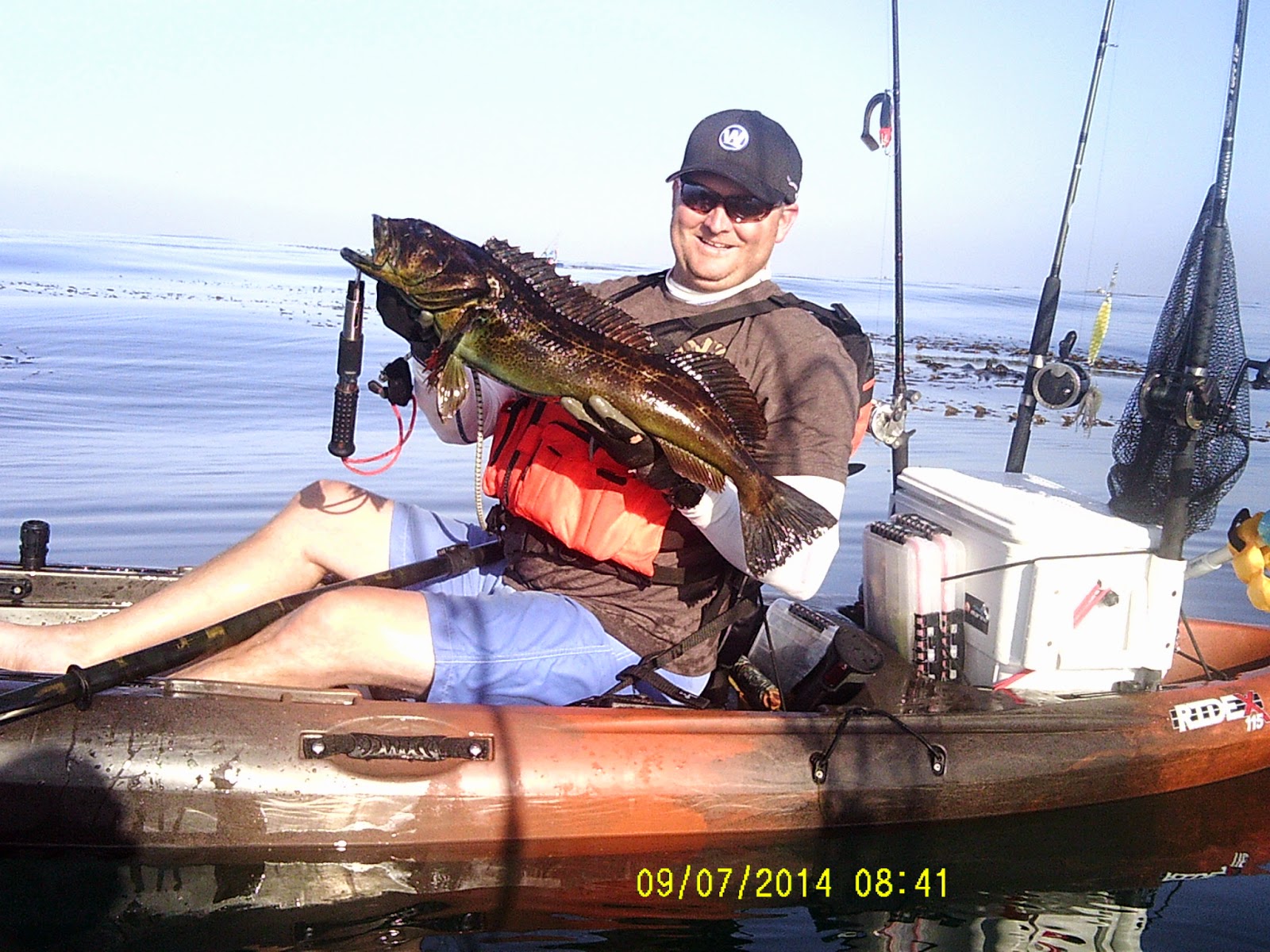
 Me with a 27" lingcod. This guy took line and doubled my rod over. It's a good one!


 Big mouth!


Jason with a nice ling! This one was about the size of mine, but came unbuttoned from his stringer and swam away...Oh well, still one out there for the tournament!

We had a good time even with the slower than usual bite and it was fun getting Jason out there. I think we may have a new fishing partner! Did anyone else get out this weekend? Post some pics in the comments!

Until next time, get out there and fish!

Cheers, Tebbs!

Monday, September 1, 2014

Which kayak is the right kayak?


Kayak Fishing Basics #2 - Choosing the right kayak

Part 1

Does this boat make me look big?

I decided to break this topic into two separate articles. Part one will address terminology and kayak types while part two will discuss purchasing considerations and buying used vs. new. 

Let's get started by defining some terminology that will be helpful to know:

BEAM -- the width of a kayak or other watercraft when measured at its widest point.
BOW -- The front or forward end of the kayak or other watercraft.
CAPACITY -- The total capacity in weight that a kayak is rated to hold. This is a maximum                              combined weight of the paddler and any load.
COCKPIT -- the opening in the kayak deck in which the paddler sits.
DECK -- The cover or top of a kayak.
HULL -- The main body or shell of a kayak. Hulls can be made of plastic, fiberglass, Kevlar,                  or wood.
SCUPPER HOLE -- May be found in the seating area, footwells and tank well of SOT kayaks.                                  These holes are self-bailing which means any water coming over the deck                                    of the kayak will automatically drain out.
SIK -- "Sit Inside Kayak" a kayak that has a cockpit where the paddler sits inside the kayak.
SPRAY SKIRT -- a piece of waterproof material that fits around the paddler and opening of a                               SIK to keep water out of the craft.
SOT -- "Sit On Top" a kayak that has the cockpit molded into the top of the kayak deck. The              paddler sits on top of the kayak rather than sitting inside of it.
STABILITY -- A measure of how difficult it is to capsize. Stability is broken down into two                                 components; Primary & Secondary.
                  Primary Stability -- Primary stability is the relative stability of a boat that is sitting                                                       flat on the water right-side-up. A lower center of gravity and/or a                                                       wider base gives increased primary stability.  
                  Secondary Stability -- Secondary stability comes into play when the boat is leaning                                                         toward its side. The more surface area touching the water                                                                 equals better stability. Good secondary stability helps keep                                                               the kayak upright when the paddler's balance goes beyond the                                                         primary stability. 
STERN -- The rear of the kayak or other watercraft.
TANK WELL -- An on deck storage area.
TRACKING
 -- Tracking is a description of a kayaks ability to go in a straight line without      compensation from the paddler.

So, now that we are speaking the same language it is time to decide whether you are a SIK or a SOT paddler. That is mostly going to depend on the type of water you fish on and of course personal preference. Generally speaking, given a sit-inside-kayak (SIK) and a sit-on-top kayak (SOT) of the same length and width, the SIK will be faster and more stable. This is because the paddler in a SIK sits lower, down inside the kayak. This lowers the center of gravity making the kayak more stable and allows the hulls to be designed narrower, optimizing speed. Another benefit of SIK's is that you tend to stay drier since you sit inside the kayak. This wide open hull also provides ample room for stowing gear, although the paddler takes up much of the forward space. One undesirable characteristic of a sit-in kayak is its ability to fill with water and "swamp" or sink. Paddlers can combat this by wearing spray skirts to keep water out, but this is something that should be considered if you fish in moving water or water that is subject to big wind chop and waves.

  Sit Inside Kayak (SIK) - Wilderness Systems Pungo 120
Photo credit - Wilderness Systems Kayaks

On the other side of the coin are the SOT's. They can be less stable than a SIK, since the paddler is sitting on top of the kayak. To offset this higher center of gravity many SOT's are designed with wider hulls and an unfortunate side effect of the wider hull is a decrease in speed. While this may not be a big concern if most of your fishing is near shore, it can be an issue if you need to cover a longer distance. There are times especially on the ocean where we may need to paddle 2 or 3 miles just to get out to the fishing grounds. Trust me, when faced with a long paddle sacrificing speed for a little added stability is not worth it. 


Sit On Top kayak (SOT) - Wilderness Systems Ride 115X
Photo credit - Juan Veruete, Wilderness Systems Kayaks

At this point I need to clarify some points. Not all sit-on-top kayaks are wide and sluggish or narrow and tippy. The modern SOT's are designed with speed, maneuverability, tracking, and stability in mind. Some are designed to be more stable and maneuverable and offer the angler the ability to stand and fish. Others are designed with sleeker lines offering greater speed and tracking.


Photo credit - Bobby Clark, Wilderness Systems Kayaks


At this point you may be asking yourself, if SIK's are faster and more stable, why paddle a SOT? Both types of kayaks can be used as fishing platforms with varying degrees of success but for me it comes down to the versatility of sit-on-top kayaks. First and foremost, most yak anglers are fishermen first and paddlers second, and the needs of kayak anglers are different from that of recreational kayakers. Kayak fisherman need room to stow gear and yet still access rods, tackle, gear, and their catch. Since the hull of a SOT is enclosed you have an open deck which includes the seating area and also provides the angler with a lot of open area to mount items like fishing crates, rod holders, camera mounts, etc. Plus most SOT's have hatches that offer access to the enclosed hull giving you access to the interior for storing gear out of the elements. Another plus of a SOT is the ability to swing your legs over the side while fighting a fish or reaching for something in the rear tank well, this just can not be done with a SIK. 

Check out that secondary stability too!
Photo credit - Dean Thomas, Wilderness Systems Kayaks

SOT's have another nice feature, scupper holes. I've talked about the possibility of SIK's filling with water if a spray skirt is not used but SOT's do not have this issue, as long as the hull is intact. The reason for this is that they are equipped with a self-bailing system that allows water to drain away from the deck via scupper holes. My personal opinion is that SOT's make the best kayaks to fish from due to their versatility, open deck space, and the ability of the paddler to move around on the kayak. While SIK's are the more traditional style and are preferred by whitewater and touring enthusiasts. For kayak anglers, SOT's are by far the more popular style. 

Finally, before deciding on any style, brand, or model try to get out and paddle as many kayaks as you can. The more you paddle, the more you will learn, and soon you will discover what YOUR perfect kayak is. In part two of this series I will talk about this, "test driving" kayaks and I will also discuss the pros and cons of going with a used kayak or dropping some coin on a brand new model. 

Until then, get out there and fish! 

Cheers, Tebbs