
Central California’s Coast, which for the purposes of ocean fishing, runs from Point Conception near Santa Barbara in the South up to Pigeon Point, near Santa Cruz in the North. This incredible and fishy stretch of coastline includes the areas of picturesque San Luis Obispo County, the beautiful and historic Big Sur region, the pristine Monterey Bay, and the rugged Santa Cruz coast. It is a paradise for anglers and outdoor enthusiasts of all types. Annually, at the New Year, the majority of saltwater fishing along this coastline closes and generally re-opens around May 1. This closure affects boat-based anglers, which includes kayak fishermen. For the first four months of every year saltwater aficionados are left counting down the days until the “groundfish” season returns. For 2015, the California Department of Fish and Wildlife has opened the rockfish (groundfish) season a month early, on April 1. For salt addicts like myself, this is welcome news and means that I will soon be back chasing one of my favorite fish to target, the toothy and aggressive Lingcod.

A toothy Central Coast lingcod.
Species and Habitat
The Lingcod (Ophiodon elongatus) is neither a Ling nor a Cod, but is a member of the Greenling family. They are found all along the west coast from the gulf of Alaska to Baja California. The biggest females of the species can grow up to 5 feet in length and weigh in at nearly 100 pounds! While large ling’s have been caught all along the West Coast, the California state record is 56 pounds, the Northwest and Alaskan waters tend to produce the larger specimens. Lingcod feed throughout the water column and I have certainly caught them at all levels, even on the surface. But, they are primarily bottom dwellers, being found in 30 to 300 feet (9 to 100 m) of water. Adult lingcod prefer hiding and nesting in the crevices of rocky outcroppings while juveniles can be found in sandy bays and areas of eel grass. The lingcod is a formidable looking predator with their sharp, fang-like teeth and muscular, elongated bodies. They are ambush predators and their blotchy dark brown, black, blue or green coloring is well suited to camouflaging them in their rocky habitat. They can be very aggressive and feed primarily on squid, octopi, crustaceans, and other fish. A fully grown lingcod will not hesitate to attack a fish similar in size to itself.

A big Ling about to be measured in at the 3rd annual Cambria Slam Down tournament.
Targeting Lingcod: Baits
Live Bait - As with most fish, live bait is always sure to entice a strike and lingcod are no different. Pinning a mackerel, squid, anchovy, or small rockfish onto a dropper loop and sending it back down into a rocky area is likely to produce a strike if ling’s are present. While using live bait can be an effective method for catching lingcod, they are not known for being shy when it comes to artificial lures. In fact, I would say that the majority of ling’s taken by recreational fishermen are caught on artificials.
Swimbaits - While there are different brands and colors, I have the best luck using paddle tail and curly tail swimbaits in the 6 to 9 inch range. I have had great success fishing for lingcod with baits from both Big Hammer and Reebs Lures. For colors, I like to match what the fish are feeding on. I find that my go to colors are blues, silvers, brown flake (root beer), and glow. The swimbait is fished by threading it onto a leadhead that is then usually dropped straight to the bottom, reeled up a few turns and then jigged up and down. I usually fish anywhere from 40 - 150 feet of water, with the majority of my time spent between 60 - 100 feet. At those depths and with a slow to moderate drift, a 3 to 4 ounce leadhead works great. On days with stronger wind or a faster current I will increase the weight of the leadhead accordingly. The goal is to keep the bait down near the bottom where the fish are.
Metal “iron” jigs - Using metal jigs is my favorite method for targeting lingcod. While I have caught many lingcod on swimbaits I have caught my largest fish on metal jigs. I like heavier jigs in the 6 ounce range and find that I have the best success with blue/white, chrome, white, or glow. My prefered lures are the jigs from Tady and the Ahi USA Assault jigs. Like swimbaits I drop the iron down and jig it a few cranks off the bottom.
Note: If I am fishing on a spot and not getting bites I will cast the jig or swimbait out and let it sink to the bottom while varying the return speed. At the same time broadcasting my casts, or fanning them out in different directions looking for an area of activity. This is a good method to use while drifting to cover more area.

The author with a 30” Central Coast Lingcod from the Ride 115X.
The setup: Rod, Reel, and Line
Rods - Fishing from a kayak, and limited on space, I like my rods to be versatile and able to handle multiple species. I have certain rods setup for different applications such as trolling or live bait fishing, while my lingcod rod is generally rigged for bottom fishing. This rod is also my standard rockfish rod but can handle a halibut or white seabass should I happen to catch one unexpectedly. For this application I look for a rod in the 10 - 25 pound range or 15 - 30 pound range. Usually rated as medium to medium heavy with a fast action. As for length, I prefer rods in the 7 foot range. They are long enough to clear the nose of the kayak, still provide good backbone for pulling fish out of the rocks and kelp, but cast better than rods in the 6 - 6 ½ foot range.
Reels - When fishing for lingcod, the majority of the time you will be jigging off the bottom. For this reason, I like conventional reels. Either level wind or lever drag will work but I prefer level wind for this application since casting is not the primary goal here. Any conventional reel with a smooth drag and decent line capacity will work fine. Many lingcod have been fought and caught with the traditional Penn Squidders and Jigmasters and these reels can often be found at a nice price. The Abu C5500 works well and is hard to beat for price and quality. For high end reels, Avet’s work great and many of the low profile reels such as the Daiwa Lexa 300/400 are outstanding.
Line - I spool my saltwater reels with 50# braid. I like the responsiveness of braided line and the “feel” of it. With braided line you can feel every little bump, tap, or strike. The downside of using 50 pound braided line is its strength. It is almost impossible to break off if you get hung up on the bottom. For this reason and to allow a little stretch in the line for fighting the fish I use a 2 - 3 foot leader of 25 pound monofilament or fluorocarbon.

The winner of the Lingcod division at the 3rd annual Cambria Slam Down tournament.
Landing a big lingcod
While it’s true that lingcod can be quite large even in our California waters and can put up a good fight, their fight is not on the scale of a Yellowtail. They will pull hard in the beginning and then make some short runs on their way to the surface. Once near the boat they will again make another dive before throwing in the towel. Once at the surface it is wise to keep their heads submerged until you are ready to land them either with lip grippers or a net. Many nice fish have been lost by raising them out of the water before the angler is ready to land them. A gaff is not usually necessary unless they are very large and you are planning on keeping the fish. It is common for lingcod to do, what I call, a “death roll” once on board and if they are in a net it can become a tangled mess of spines, teeth, and hooks. For this reason I prefer to use some type of lip gripper to control the fish. I have had large lingcod on board my kayak that have wreaked havoc on my equipment, breaking my fishfinder mount and knocking unsecured gear overboard. A word of advice, before landing these sharp-toothed, aggressive fish have your gear secured and be ready for a fun battle!
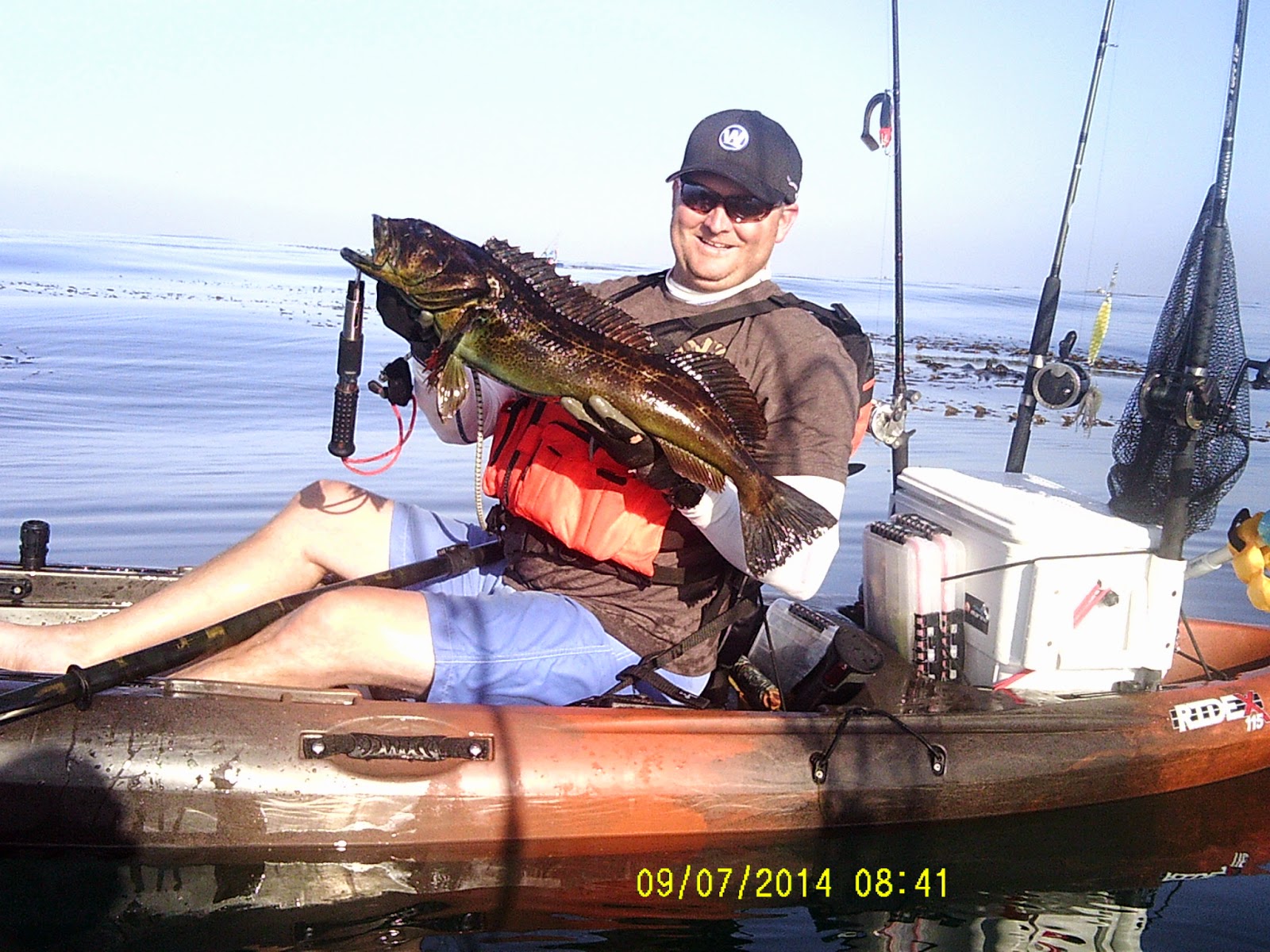
Wilderness Systems and AT Paddles pro staff member Eric Tebbets with a nice Lingcod from the waters along northern San Luis Obispo County.
Conservation
In my local fishery along the Central California Coast, aside from migratory species, Lingcod are the big dogs on the block. They are the alpha predator of the reefs and rock piles, and they are great fun to catch with their aggressive attacks and hard pulls. They also happen to be one of the best eating fish around. For this reason, they are a prized fish for both commercial and recreational anglers. To maintain a healthy and sustainable population, wildlife agencies have implemented restrictions on the size and daily limit for lingcod. This year, within California’s Central Management Zone the daily bag limit for lingcod has been raised from 2 to 3 with a minimum length of 22 inches. Since regulations vary between regions and States, be sure to check your local fishery for size and bag limits. Lingcod lend themselves to the practice of catch and release since, unlike typical rockfish species, lingcod do not have an air bladder. So, raising them from depth does not harm them and they can easily be released with proper handling techniques. The biggest lingcod are the females and the bigger they are the more eggs they produce when breeding. By releasing the larger females and retaining the fish in the 24 - 30 inch range you are helping promote the lingcod population. Please, eat what you keep and consider returning the larger fish to continue growing the species for future generations to enjoy. Catch, picture, and release!


