Showing posts with label estero bay kayak fishing. Show all posts

Wednesday, June 10, 2015

1st Annual Estero Kayak Challenge Results

Sunday, June 7, 2015 was awesome! We held the 1st Annual Estero Kayak Challenge and had 49 anglers compete for almost $2000 in 4 divisions. We called this tournament the Estero Kayak Challenge for 2 reasons. First, it was held within Estero Bay on California's Central Coast and the Northern boundary was Estero Point. The second reason, the fishing can be tough in this area, hence the "challenge". As you can see from the results, there were many who didn't weigh in any fish at all, while others were able to find some nice ones.
A very big congratulations to Jim Gosciminski, our tournament champion! Jim, took the win in 2 divisions. He took the Lingcod division with a solid 10 pound 9 ounce hawg and in the 2 fish division added a nice 6 pounder to his other ling for a total of 16 pounds 9 ounces! Way to go Jim!
His buddy, Mike Sapp who traveled down with him from the Santa Cruz area, took 2nd place in the Lingcod division with a heavy 9 pound 10 ounce ling, followed by Ren Reidel in 3rd with a very nice 7 pound 5 ounce fish of his own. Solid fish boys!
In the Rockfish division there was some very tight competition with quite a few guys tieing, luckily all of the ties were lower on the leaderboard. Just like at last years 3rd Cambria Slam Down tournament, Carlos Cantu took the win in the rockies! Congrats Carlos, nice work in some tough conditions. Carlos was followed by Billy Hurst and Jason Potts, in third and fourth respectively. Awesome job guys!
The Cabezon division was very tough. It is a good thing we were only paying out 3 places because only 3 cabs were brought in all day. The cool thing, is that all 3 of those cabbies would have been contenders even if more had been caught. Kenny Nakamura, from Roseville, took the win with a fat 6 pound 5 ounce cabby, followed by Dusty McAdon with a fatty of his own at 5 pounds 3 ounces. For a while we thought that might be it for the cabs. Then Justin Vermillion, one of the last to come in, brought the final one to the scale. It came in at 4 pounds 10 ounces and secured him third place. Very cool boys!
We saw some nice fish brought in, including a swell shark caught by Carny Stuart-Williams. He rushed the shark to the scale where we took a quick weight then he ran it back down to the water and released it safely. It was awesome to see that beautiful shark and to have it released back into the water. Next year, we will take a look at the 2 fish division and add some restrictions to the allowable species for the sake of conservation.
The raffle for HOW was a great success, we ended up raising more than $2700! All of which will go to our new local chapter. William Platte of Los Osos, a veteran himself, was the winner of the Wilderness Systems Kayaks Thresher 140. Very happy for you Willy!
Thank you to all of our wonderful sponsors who donated to the event and made it a success. You all rock! A list of our sponsors can be found here.
Thank you to all who came out and made the event a success and to all the awesome sponsors who donated items to the Heroes on the Water raffle. I am already looking forward to next years event when we can do it again!
Here are the final results:
Division 4 - 2 Fish Tournament Champion
1st Place - Jim Gosciminski 2 lings - 16 lbs 9 oz - $490
2nd - William Platte 12 lbs 7 oz
3rd - Brian Valenzuela 12 lbs 12 oz
4th - Ren Reidel 11 lbs 13 oz
5th - Nick Lana 10 lbs 7 oz
6th - Alan Kupstas 10 lbs 10 oz
7th - Chad Johnson 10 lbs
8th T - Carny Stuart-Williams 9 lbs 7 oz
8th T - Justin Vermillion 9 lbs 7 oz
10th - Bob Joslin 8 lbs 13 oz
11th - Phil Lopez 8 lbs 12 oz
12th - Jason Potts 8 lbs 8 oz
13th - Kenny Nakamura 8 lbs 4 oz
14th - Ricardo Holden 7 lbs 15 oz
15th - Andy O'Brien 7 lbs 3 oz
16th T - John Gonzalez 7 lbs 1 oz
16th T - Mason Radke 7 lbs 1 oz
18th - Roy Arnold 7 lbs
19th - Eli Campos 6 lbs
Division 1 - Rockfish
1st Place - Carlos Cantu 3 lbs 14 oz - $245
2nd Place - Billy Hurst 3 lbs 2 oz - $145
3rd Place - Jason Potts 2 lbs 15 oz - $100
4th - Andy O'Brien 2 lbs 14 oz
5th T - Brian Valenzuela 2 lbs 10 oz
5th T - Nick Lana 2 lbs 10 oz
7th T - Corey Hamblin 2 lbs 9 oz
7th T - Ricardo Holden 2 lbs 9 oz
9th T - Chad Johnson 2 lbs 5 oz
9th T - Ren Reidel 2 lbs 5 oz
11th T - Alan Kupstas 2 lbs 4 oz
11th T - Justin Vermillion 2 lbs 4 oz
13th - Eli Campos 2 lbs 2 oz
14th T - Erik Nordholm 2 lbs 1 oz
14th T - Mason Radke 2 lbs 1 oz
16th - Robert Marlow 2 lbs
17th T - Roy Arnold 1 lb 15 oz
17th T - Kenny Nakamura 1 lb 15 oz
19th - John Gonzalez 1 lb 8 oz
20th - Carny Stuart-Williams 1 lb 5 oz
Division 2 - Cabezon
1st Place - Ken Nakamura 6 lbs 5 oz - $245
2nd Place - Dusty McAdon 5 lbs 3 oz - $145
3rd Place - Justin Vermillion 4 lbs 10 oz - $100
Division 3 - Lingcod
1st Place - Jim Gosciminski 10 lbs 9 oz - $245
2nd Place - Mike Sapp 9 lbs 10 oz - $145
3rd Place - Ren Reidel 7 lbs 5 oz - $100
4th - William Platte 7 lbs 2 oz
5th - Brian Valenzuela 6 lbs 11 oz
6th - Alan Kupstas 6 lbs 2 oz
7th - Nick Lana 5 lbs 14 oz
8th T - Jason Potts 5 lbs 9 oz
8th T - John Gonzalez 5 lbs 9 oz
10th - Phil Lopez 5 lbs 8 oz
11th T - Dan Fleming 5 lbs 6 oz
11th T - Chad Johnson 5 lbs 6 oz
13th - Carny Stuart-Williams 5 lbs 4 oz
14th - Roy Arnold 5 lbs 1 oz
15th - Mason Radke 5 lbs
16th - Justin Vermillion 4 lbs 11 oz
17th T - Bob Joslin 4 lbs 12 oz
17th T - David Chaves 4 lbs 12 oz
19th - Andy O'Brien 4 lbs 5 oz
20th - Ricardo Holden 4 lbs 4 oz
21st - Eli Campos 3 lbs 14 oz
22nd - Doug Browand 3 lbs 11 oz

Friday, May 15, 2015

Estero Kayak Challenge - 3 weeks away!

Update 5/15 - We are getting a great turnout as we get closer to the event, 44 anglers competing! There is still time to register if you haven't yet. Remember, there is no day of registration and we are 3 weeks away, so get those entries in. I would love to see us hit 50 anglers, can we do it? 

Even if you don't fish in the event, come out for some fun in beautiful Cayucos, Ca and help us celebrate the new Central Coast Chapter of Heroes on the Water!

1. Erik Nakamura - shogunofthecity
2. George Jercich - iZod
3. Ryan Howell - RHYAK
4. Eli Campos
5. Andy O'Brien - Dogpound
6. Billy Hurst
7. Bob Joslin
8. Kenny Nakamura - KennyKayak
9. Jeff Hopp
10. Eric Tebbets - Surfbrewer
11. Chad Britton - LOpaddler
12. Alan Kupstas
13. John Calvert
14. Robert Marlow - Squawfish
15. William Platte
16. Jesse Poquette - allwet
17. Phil Lopez - Lopezcador
18. Mike Watt
19. Jason Potts
20. Brian Nakamura - Nakatack
21. Kenny Wimer
22. Roy Arnold - Sideroad
23. Bill DuMong - Billydog
24. Nick Lana - Madcat
25. Chad Johnson
26. Justin Vermillion - J_Verm
27. Rendall Reidel
28. Gary Valerio
29. Barton Riggs
30. James Gosciminski
31. Eddie Falch
32. Jeffrey Veteto
33. Dustin McAdon
34. Carney Stuart-Williams
35. John Gonzalez
36. Michael Sapp
37. Corey Hamblin - Cor-Dawg
38. Ricardo Holden - Fisheye Channel
39. Rolland Felton - rfelton
40. Josh Knoll - CenCal-HOW
41. Daniel Mark Fleming
42. Carlos Cantu
43. Scott Kopp - FlyYaker
44. Brian Valenzuela

Thursday, April 2, 2015

Chasing Lingcod From a Kayak

Central California’s Coast, which for the purposes of ocean fishing, runs from Point Conception near Santa Barbara in the South up to Pigeon Point, near Santa Cruz in the North. This incredible and fishy stretch of coastline includes the areas of picturesque San Luis Obispo County, the beautiful and historic Big Sur region, the pristine Monterey Bay, and the rugged Santa Cruz coast. It is a paradise for anglers and outdoor enthusiasts of all types. Annually, at the New Year, the majority of saltwater fishing along this coastline closes and generally re-opens around May 1. This closure affects boat-based anglers, which includes kayak fishermen. For the first four months of every year saltwater aficionados are left counting down the days until the “groundfish” season returns. For 2015, the California Department of Fish and Wildlife has opened the rockfish (groundfish) season a month early, on April 1. For salt addicts like myself, this is welcome news and means that I will soon be back chasing one of my favorite fish to target, the toothy and aggressive Lingcod.

A toothy Central Coast lingcod.

Species and Habitat


The Lingcod (Ophiodon elongatus) is neither a Ling nor a Cod, but is a member of the Greenling family. They are found all along the west coast from the gulf of Alaska to Baja California. The biggest females of the species can grow up to 5 feet in length and weigh in at nearly 100 pounds! While large ling’s have been caught all along the West Coast, the California state record is 56 pounds, the Northwest and Alaskan waters tend to produce the larger specimens. Lingcod feed throughout the water column and I have certainly caught them at all levels, even on the surface. But, they are primarily bottom dwellers, being found in 30 to 300 feet (9 to 100 m) of water. Adult lingcod prefer hiding and nesting in the crevices of rocky outcroppings while juveniles can be found in sandy bays and areas of eel grass. The lingcod is a formidable looking predator with their sharp, fang-like teeth and muscular, elongated bodies. They are ambush predators and their blotchy dark brown, black, blue or green coloring is well suited to camouflaging them in their rocky habitat. They can be very aggressive and feed primarily on squid, octopi, crustaceans, and other fish. A fully grown lingcod will not hesitate to attack a fish similar in size to itself.

A big Ling about to be measured in at the 3rd annual Cambria Slam Down tournament.

Targeting Lingcod: Baits


Live Bait - As with most fish, live bait is always sure to entice a strike and lingcod are no different. Pinning a mackerel, squid, anchovy, or small rockfish onto a dropper loop and sending it back down into a rocky area is likely to produce a strike if ling’s are present. While using live bait can be an effective method for catching lingcod, they are not known for being shy when it comes to artificial lures. In fact, I would say that the majority of ling’s taken by recreational fishermen are caught on artificials.


Swimbaits - While there are different brands and colors, I have the best luck using paddle tail and curly tail swimbaits in the 6 to 9 inch range. I have had great success fishing for lingcod with baits from both Big Hammer and Reebs Lures. For colors, I like to match what the fish are feeding on. I find that my go to colors are blues, silvers, brown flake (root beer), and glow. The swimbait is fished by threading it onto a leadhead that is then usually dropped straight to the bottom, reeled up a few turns and then jigged up and down. I usually fish anywhere from 40 - 150 feet of water, with the majority of my time spent between 60 - 100 feet. At those depths and with a slow to moderate drift, a 3 to 4 ounce leadhead works great. On days with stronger wind or a faster current I will increase the weight of the leadhead accordingly. The goal is to keep the bait down near the bottom where the fish are.


Metal “iron” jigs - Using metal jigs is my favorite method for targeting lingcod. While I have caught many lingcod on swimbaits I have caught my largest fish on metal jigs. I like heavier jigs in the 6 ounce range and find that I have the best success with blue/white, chrome, white, or glow. My prefered lures are the jigs from Tady and the Ahi USA Assault jigs. Like swimbaits I drop the iron down and jig it a few cranks off the bottom.


Note: If I am fishing on a spot and not getting bites I will cast the jig or swimbait out and let it sink to the bottom while varying the return speed. At the same time broadcasting my casts, or fanning them out in different directions looking for an area of activity. This is a good method to use while drifting to cover more area.

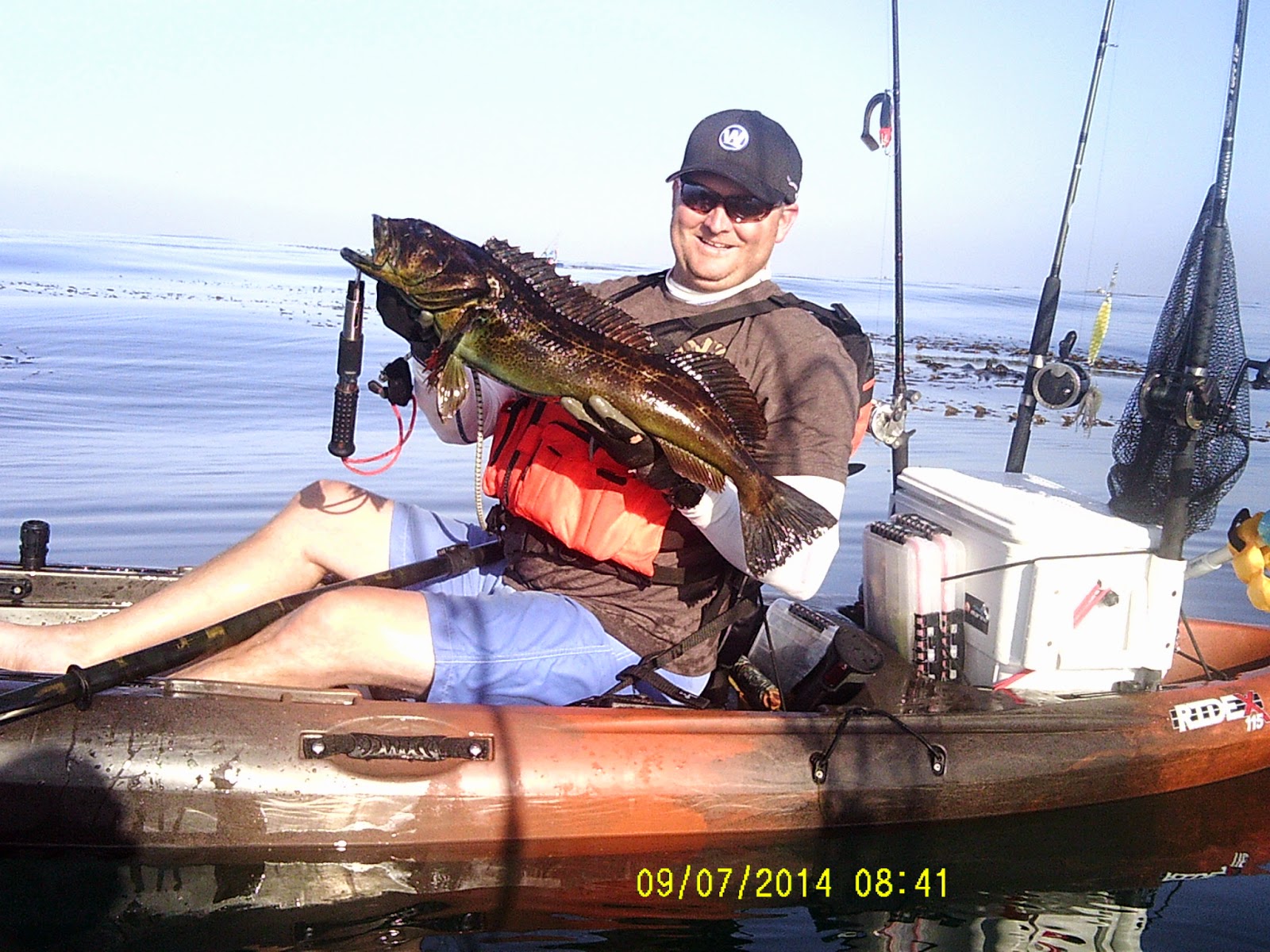
The author with a 30” Central Coast Lingcod from the Ride 115X.


The setup: Rod, Reel, and Line


Rods - Fishing from a kayak, and limited on space, I like my rods to be versatile and able to handle multiple species. I have certain rods setup for different applications such as trolling or live bait fishing, while my lingcod rod is generally rigged for bottom fishing. This rod is also my standard rockfish rod but can handle a halibut or white seabass should I happen to catch one unexpectedly. For this application I look for a rod in the 10 - 25 pound range or 15 - 30 pound range. Usually rated as medium to medium heavy with a fast action. As for length, I prefer rods in the 7 foot range. They are long enough to clear the nose of the kayak, still provide good backbone for pulling fish out of the rocks and kelp, but cast better than rods in the 6 - 6 ½ foot range.


Reels - When fishing for lingcod, the majority of the time you will be jigging off the bottom. For this reason, I like conventional reels. Either level wind or lever drag will work but I prefer level wind for this application since casting is not the primary goal here. Any conventional reel with a smooth drag and decent line capacity will work fine. Many lingcod have been fought and caught with the traditional Penn Squidders and Jigmasters and these reels can often be found at a nice price. The Abu C5500 works well and is hard to beat for price and quality. For high end reels, Avet’s work great and many of the low profile reels such as the Daiwa Lexa 300/400 are outstanding.


Line - I spool my saltwater reels with 50# braid. I like the responsiveness of braided line and the “feel” of it. With braided line you can feel every little bump, tap, or strike. The downside of using 50 pound braided line is its strength. It is almost impossible to break off if you get hung up on the bottom. For this reason and to allow a little stretch in the line for fighting the fish I use a 2 - 3 foot leader of 25 pound monofilament or fluorocarbon.

The winner of the Lingcod division at the 3rd annual Cambria Slam Down tournament.

Landing a big lingcod


While it’s true that lingcod can be quite large even in our California waters and can put up a good fight, their fight is not on the scale of a Yellowtail. They will pull hard in the beginning and then make some short runs on their way to the surface. Once near the boat they will again make another dive before throwing in the towel. Once at the surface it is wise to keep their heads submerged until you are ready to land them either with lip grippers or a net. Many nice fish have been lost by raising them out of the water before the angler is ready to land them. A gaff is not usually necessary unless they are very large and you are planning on keeping the fish. It is common for lingcod to do, what I call, a “death roll” once on board and if they are in a net it can become a tangled mess of spines, teeth, and hooks. For this reason I prefer to use some type of lip gripper to control the fish. I have had large lingcod on board my kayak that have wreaked havoc on my equipment, breaking my fishfinder mount and knocking unsecured gear overboard. A word of advice, before landing these sharp-toothed, aggressive fish have your gear secured and be ready for a fun battle!

Wilderness Systems and AT Paddles pro staff member Eric Tebbets with a nice Lingcod from the waters along northern San Luis Obispo County.

Conservation

In my local fishery along the Central California Coast, aside from migratory species, Lingcod are the big dogs on the block. They are the alpha predator of the reefs and rock piles, and they are great fun to catch with their aggressive attacks and hard pulls. They also happen to be one of the best eating fish around. For this reason, they are a prized fish for both commercial and recreational anglers. To maintain a healthy and sustainable population, wildlife agencies have implemented restrictions on the size and daily limit for lingcod. This year, within California’s Central Management Zone the daily bag limit for lingcod has been raised from 2 to 3 with a minimum length of 22 inches. Since regulations vary between regions and States, be sure to check your local fishery for size and bag limits. Lingcod lend themselves to the practice of catch and release since, unlike typical rockfish species, lingcod do not have an air bladder. So, raising them from depth does not harm them and they can easily be released with proper handling techniques. The biggest lingcod are the females and the bigger they are the more eggs they produce when breeding. By releasing the larger females and retaining the fish in the 24 - 30 inch range you are helping promote the lingcod population. Please, eat what you keep and consider returning the larger fish to continue growing the species for future generations to enjoy. Catch, picture, and release!

Thursday, March 12, 2015

The Estero Kayak Challenge is getting closer!

Damn! So, March is already half way done and we are closing in on the June 7 date for the Estero Kayak Challenge. I wanted to remind those of you planning on signing up that after May 1st there is no longer a t-shirt included and the price goes up to $100! So, get those entries in!

We will soon be announcing the sweet kayak that will be up for raffle and all of our awesome sponsors are sending us some incredible gear! Head over to the sponsor page here on the blog to see the great list of sponsors.

We have a great group of anglers signed up already and we are looking for even more! Head over to the info. and registration pages, we hope to see ya there!

Sunday, February 22, 2015

Morro Bay Perch Derby

I made it out today for the first Morro Bay Perch Derby and my first tournament of 2015. This was a small event, primarily members of the Central Coast Kayak Fishing group, and a winner take all tournament. A fun little derby style tournament with a cash pot and a small raffle put on by one of the local sportfishing shops, Morro Bay Landing. I loaded up the kayaks the night before and arrived the following morning at Morro Bay Landing to sign-in and pay up.

After paying and signing in, I made my way down to the launch spot at Coleman Beach inside the bay. The weather was overcast with a chance of rain in the forecast but, the temperature was a nice 65 degrees and the wind was calm. We took the kayaks down to the beach and everyone got rigged up in anticipation of the 7:30 launch time.
The Wilderness Systems crew rigged and ready to go with 2 Thresher's and a Ride 115X Max.

At 7:30, as if on que, a light rain began to fall and the wind started to awaken. Not to be deterred, we grabbed our paddles and hit the water in search of the targeted species. This day we were looking for 3 different species of perch. The Black Perch, Pile Perch, and Rubber Lip Perch. Each angler was allowed to measure-in their single biggest of each of these 3 fish and that made up the anglers catch for the day. The angler with the highest total combined length would take home the pot.

The water was calm and the tide was slack so for the first hour or so we had nice conditions even with a little bit of rain. After that though, even with the rain stopping, the wind increased and the tide changed making fishing tough. The bite was hot and cold with most catching the more common black perch and having trouble finding the pile and rubber lips.
Andy O'Brien, Wilderness Systems ProStaff and Deep 6 Fishing team member, braving the rain and doin' a little perchin'

I caught my first fish about an hour in to the competition but as I was putting it on the board to measure it, it slipped through my hands and back into the water! DAMN!!! Oh well, the bite seemed to be picking up and I was soon rewarded with another black perch, this one sticking around for his photo before being sent back home.

A nice black perch, these really are pretty little fish.

From there we worked our way along the embarcadero working in and around the piers and docks. 

I'd like to see a boat get beneath the piers and work these areas. The advantage of fishing from a kayak!

With the day wearing on the bite began to slow as the wind and tide increased making it difficult to target one area. The general consensus on the water was that no one had, as of yet, been able to bag all 3 species. The door was still open but time was slipping away with the 2:00 weigh-in getting nearer. After working my way south along the wharf for a few hours, I decided to start working my way back north toward the launch to be closer for the weigh-in. 

I was able to hook a few more black perch but I was having trouble expanding beyond that. Eventually I found a nice area where the bottom dropped off into one of the deeper channels within the bay. I cast my carolina rigged pile worm out into the deep water and slowly brought it up the slope. Midway, my light weight rod bent over and I was hooked up! This one fought different than the blacks I had been catching and getting it to the surface I saw that it was a nice sized pile perch. Landing it and getting it on the board it came in at 13 1/2", respectable for a pile perch though they do get a bit bigger.

Pile perch that almost brought home the win.

At this point the day was getting on near the weigh-in but not knowing if anyone had gotten all 3 species I tried for a bit longer to get the trifecta. It was not to be this day so with 30 minutes left before cut-off I landed and quickly loaded up my gear. I arrived at the weigh-in with 10 minutes to spare only to find out that I had been edged out by 2 1/2"! The winner measuring in a black perch and a big rubber lip perch. Two fish! That's all it took this day to walk away with over $400. 

The happy winner with his catch and his clams! Way to go Roy! Nice work buddy.


Willy B taking home the $50 gift certificate from Morro Bay Landing in the raffle. Nice on Willy!


The yougest angler competing today. Owen, the son of Wildy ProStaffer and Deep 6 Fishing's Chad Britton. Owen held his own out there today and ended up winning a shirt from Morro Bay Landing in the raffle. Way to go Owen!

With the sun shining, friendships were cemented over fish stories and the comraderie of the kayak fishing life.

The father/daughter duo - Scott with his favorite fishing partner, his daughter Tessa. Great to see the kids come out for the event!

A couple of people missing from the photo but this is the gang from today. Another fun kayak fishing event in the books. Good fishing, good friends, and good times!

As much as I like the bigger tournaments and enjoy the competition and their ability to raise money for organizations and causes, these smaller "local" tournaments are awesome!  Getting together with your local club or online forum is a great way to build up your local kayak fishing scene and even get new members involved. It gets the group together, gets the kids and families involved, and builds that fishing comraderie that we all enjoy. 

Congratulations to Roy Garner on his win (did I mention that Roy paddles a Wilderness Systems Ride 135?!, YEAH!) and thank you to Derrick and Ryan from Central Coast Kayak Fishing for putting this together. It was a great time fellas! Also, thank you to Morro Bay Landing for their hospitality and generosity, very cool dudes!

OK folks, until next time...Get out there and fish! 

Cheers, Tebbs!

Friday, January 30, 2015

Wilderness Systems Prostaff 2015

I am very happy to announce that I have been asked to renew my prostaff contract with Wilderness Systems Kayaks and Adventure Technology Paddles for another year. Wilderness Systems and AT have been very supportive and I am honored to be in the company of one of the best pro staffs in the business. Two of my buddies also made the teams this year and I would like to welcome Chad Britton and Andy O'Brien to 2015 WIldy and AT pro staffs as well! Well done fellas!

Sunday, January 4, 2015

New Years halibut video

Here is a video I did of the New Years Eve halibut catch from Cambria, Ca

New Years Eve Halibut Video


New Years Eve 2014...Wind, Halibut, and a Mayday!

First off, Happy New Year! This is my first post of 2015 and I post it with the hope that we can all learn something or at least to reaffirm what many of you already know. It is kind of long but I hope that you enjoy it. After reading, post up your thoughts and any experiences you have had where you found yourself in trouble on the water. 

12/31/2014 @ 07:45 - A group of 7 of us arrived at Leffingwell Landing in Cambria, Ca to find choppy seas and a steady east (offshore) wind.  After some discussion of alternate locations and pros and cons we decided to give it a shot. The wind seemed to be dropping and by the time we launched the wind was noticeably less and the sea was starting to lay down. 


Our launch location on a calmer day

08:30 - We had an easy launch and it really wasn't bad at all out on the water. We all worked our way out, a few of us getting out to 100 feet of water. At that spot I was marking some good fish feeding on a cloud of bait so I dropped a double hook, rock fish fly rig and immediately hooked up. It felt like a couple of small blues but as I brought it up I was surprised to see 2 decent sized macks. I lost one of them while unhooking the other. I figured since I had some good live bait I would give it a shot and see what I could make happen on this last day of the California rock fish season. I dug out a dropper loop rig that I had in one of my boxes. I pinned the mack through the nose on the in line loop and attached a Big Hammer Swimbait on a 4 oz. jig head on the bottom of the rig. The mackerel immediately took off with some really good, lively action. I had drifted out into 120 feet of water while rigging up the mack so I started to slowly work my way back in toward the rest of the guys hitting some structure here and there as I went.

09:30 - The wind was starting to pick up again and some of the guys were starting to slowly work their way in closer to shore. We began to do the same but just as we did my rod slowly doubled over like I had gotten snagged on the drift. After taking the rod out of the holder I gave it a little tug to see if I could un-snag it and it gave a tug back. Oh Yeah! Fish on! I gave the reel a few cranks and then the fish headed for the floor, peeling off line as it went. It made a good hard run and went straight to the bottom and stayed there. I told my partner, "this is either a really big ling or its a nice Halibut or White Seabass!". It took a little while to coax it up off the bottom and then it was just a matter of hauling in dead weight on the end of the line. It made one more small run and I was finally able to get it to the surface. At first color I initially thought it was a hawg of a lingcod then it turned and I saw the wide, flat body of a halibut. Hell yeah! I missed my first gaff shot, hitting it square in its dome. The second one found its mark right under its head in the soft underside. Once on the gaff I knew he was mine. I let out a huge WHOOP! and got him on the clip. I hooked him in 100 fow and he came in at just under 36" and just shy of 25 lbs.

Approx. 10:00 - Once I got the fish secured on the clip, got my gear stowed, and laid him on my lap for the paddle in I realized how far south-west we had been blown by the wind. It also became clear that the wind was no longer just a nuisance, it was now a force to reckon with. It was myself and another member of our group who had stayed by my side during the battle with the fish in case I needed assistance. I was able to make slow progress against the wind in my Wilderness Systems Thresher 140, while continuing to check behind to make sure my partner was doing the same. The wind was continuing to build as were the seas. We started taking some pretty good chop over the bows and spray in our faces. The sea had turned angry my friends! As I struggled to make headway of my own I noticed that my partner was not, in fact it looked as though he was losing ground. I radioed another member of the group to report our situation but due to the wind noise and his own struggle to get back to shore we had trouble communicating. We continued to battle the wind and I made the decision to remain with my partner seeing that he was not going to be able to make it back in. I relayed to the others that we were going to need assistance but communications were still difficult. Finally, I made a difficult decision, I switched to channel 16 and called Mayday, Mayday, Mayday...

Making that call was one of the harder things I have had to do. I work for the fire department! I am the one people call for help, I knew my friends and co-workers were going to hear about it, and my own ego was screaming at me to quit jacking around and paddle for shore! But the reality of the situation was that we were in trouble and further delay was just going to make it worse. 


The USCG arriving at our location

..."vessel with the mayday, continue with your emergency" or something like that. To my surprise it was the USCG out of Long Beach calling me back. I figured it would be the local Morro Bay station but Long Beach (approx. 4 hours south of my location) had picked up my transmission on my little handheld vhf on channel 16. They relayed the information to Morro Bay and from that point I communicated with them. It took a little work to get them our position using landmarks on shore and our general position relative to shore. It took the vessel approx. 1 hour to make it up the coast to us (they temporarily got diverted to an overturned kayaker off of Cayucos, but he was rescued by the Morro Bay Harbor Patrol). At this point we were approximately 3 miles offshore and 5 miles south of the bridge at Leffingwell (our launching location), in 240 feet of water. Now, that distance wouldn't normally be an issue but with the strong offshore wind we may as well have been 100 miles out. While waiting for the Coast Guard we did our best to stay together and and to keep our bows faced into the wind and our kayaks upright. Eventually, the wind did start to subside and we were able to make some headway back towards land, getting to 190 feet of water at the time of pick up. 


Approx. 11:00 - The Coast Guard arrived and we could hear the 47' Motor Life Boat before we could see it. Once they reached the area they were able to pinpoint our location by zeroing in on our radio transmission and came and picked us up. They were great guys who were more concerned with the fact that we had a fat halibut on board than they were about chastising us for our predicament. They hauled all of our gear on board and gave us a ride back in closer to shore. After taking some pics with the crew, did I mention how awesome they were, they dropped us off and we paddled the rest of the way back in. On our ride back in, the boat passed by a couple more guys from our group who had also been blown out and were working their way back in with the reduced winds. The USCG dropped us next to them and we all made it back in together safe and sound, but very tired. 


A couple members of the Morro Bay USCG crew that came to our aid

Out of the 7 who launched together, 4 were blown offshore and the other 3 had battles of their own to make it back in. All members stayed on hand until they were sure that everyone was accounted for and safely back onshore. We all shared some happy, relieved, and sheepish laughs once reunited, glad to be able to share our story and looking forward to fishing together again.

Understandably, some people are saying that we put safety aside to fish, perhaps we did. But there was 7 of us there, the conditions that we saw and the forecast that we were working off of (showing the winds decreasing as the day wore on) looked to us favorable and they were indeed declining. It was basically a 2 hour window, from about 10:00 - 12:00, of strong wind that blew us out and led to the eventual rescue. When we were dropped off the winds had died away to a calm breeze and the water looked beautiful. 


Back on shore with almost 25 lbs. of BUTT! You can see in the background how calm the sea had become again.

The following day I took 2 large bags of halibut filets over to the boys at the USCG station as a thank you. Thanks again guys!

Lessons learned...

1. Never underestimate the effect the wind can have on you, especially an east wind on the west coast. Had we stayed in shallower and fished the kelp we would have been in better shape and most likely could have made it back on our own.

2. Never, ever, leave shore without a fully charged and functional vhf radio. This will be my mantra forever.

3. Always, always wear your PFD. Had we gone in the water and lost our grip on our yaks, it is very likely that we would have been separated from it very quickly in the wind and chop. We were in very choppy seas in 54 degree water. No PFD would likely have proven fatal.

4. Both of us normally have a gps unit with us but on this day neither of us had our with us, of course. Even though the USCG was able to find us, giving them our exact coordinates would have made it much easier. If your fish finder doesn't have gps, think about bringing a handheld unit with you.

5. Fish with a partner and stick within sight of each other. I think having 2 of us together kept the stress of the situation down as we were able to talk and somewhat joke about the situation. We were wondering how Fiji was this time of year.

6. Finally, if you think you are in trouble and are going to need help. DO NOT WAIT to make the call. Get help coming and if you end up not needing them you can cancel them. Remember, there is lag time involved with getting that help in place and to you. 


Well, there you have it, in full detail. Questions, comments let them fly. I hope that by sharing this somewhat humiliating experience others can learn from it. I'll post a video of the halibut catch once I get it together. 
Thanks for reading.

Cheers, 

Tebbs

Tuesday, December 30, 2014

Is there a perfect "kayak" rod?

I was re-reading this article by Kevin Nakada, http://www.kayakfishmag.com/gear/kayak-specific-rods/, and it got me thinking, which is always trouble Roll Eyes  What would be the "perfect" kayak rod? Does it need to float or have some kind of tether attachment point? Talking specifically about rod layout (grips, reel seat, weight, length, etc.) and taking power, action, line and lure weight out of the equation. My thought is that a rod can be built to fit different styles of fishing and actions but what features would make a rod a specific "kayak" rod? 

So, is there a perfect length or specific equation? I suppose it comes down to the environment you fish in, but speaking of your bread and butter rod for your local waters, what would be your perfect "kayak" rod?. 

For me a lighter weight rod but with good backbone to coax the hawgs up to the surface, in the 7' - 7'6" range. It would have a moderate length rear grip, min. 8" up to 12" and probably split grip to keep the weight down and it would need a decent length fore grip, 5"-8". One of my favorite rods is a Powell "Diesel" Rod, 10-17# line wt., med.-hvy., fast action. It can handle some heavy fish and does it well but it lacks a fore grip and there have been times that I wished it had one. A graphite reel seat, strong but light and sturdy guides that can handle a little banging around. Also, a rod leash attachment point on the butt end of the rear grip. I currently attach my rod tether up near the reel and its a pain in the ass, always seems to be in the way. There it is:


7'-7'6" length,
8"-12" rear grip,
strong, yet light graphite reel seat,
5"-8" fore grip,
durable line guides, and
an attachment point on the butt end for a rod tether.

What would be your "perfect" kayak rod? 

Cheers, Tebbs!

Thursday, December 18, 2014

Off-Season Maintenance

Here on the west coast the groundfish season, which includes Rockfish, Lingcod, Cabezon, Sheepshead, Ocean Whitefish and otherscloses on December 31. It's a time when us saltwater yak guys turn to the shores for some surf and rock fishing and the lakes for some bass and trout fishing. It is also an opportunity to do some much needed and often deferred maintenance on our salt gear. 

During the open season it can be difficult to find the time to do more than a good rinse with fresh water after each use, at least for me. That is why once the season closes I like to do a thorough tear down and cleaning of my gear. Here is the technique that I use and that works for me. 

I do one rod and reel setup at a time, from start to finish. This helps me keep components organized and separate from each other. 

Step 1. Remove the reel from the rod and set aside. 

Step 2. Give the entire rod a good cleaning with warm, soapy water and a gentle scrub brush. Cleaning the rod first, removes built up grime and allows you to see problems during your inspection. 


Step 3. Do a thorough inspection of the rod starting with the grips and working your way to the tip.

Butt Cap - This is the cap at the very bottom of the rod. It protects the butt of the rod and should be 
securely in place.
          
EVA Foam grips - Modern EVA is very durable and requires very little maintenance. I generally just give it a good wash down with warm soapy water and inspect for defects that could cause problems such as looseness on the rod blank, which is rare.

Cork grips - I love the feel of cork and it is a time tested material but it does pick up more contaminants than EVA and is subject to more wear and tear. Again, I check to ensure the grip is secure to the rod blank and that there are no cracks or major defects. Then I wash the grip with warm soapy water and a gentle brush. If you find there is grime that you can not remove with this method try using a small amount of denatured alcohol. 

Reel Seat - Your reel seat keeps your reel solidly in place. If it breaks you are out of service. That is why it is important not to over tighten your seats. I begin by looking at the threads for signs of damage such as flattening or cuts in the threads. When cleaning and inspecting the threads be sure to move the hood all the way up and down to get to all of the threads. I then check the hoods for cracks and damage that may affect their ability to secure the reel. I also make sure the seat is securely attached to the rod blank. You do not want your reel seat coming loose and moving.


Guides, Tip Top, and Wraps - Continue to work your way up the rod checking each of the guides and guide wraps as you go. When inspecting the guides look for physical damage such as loose, bent, or broken 
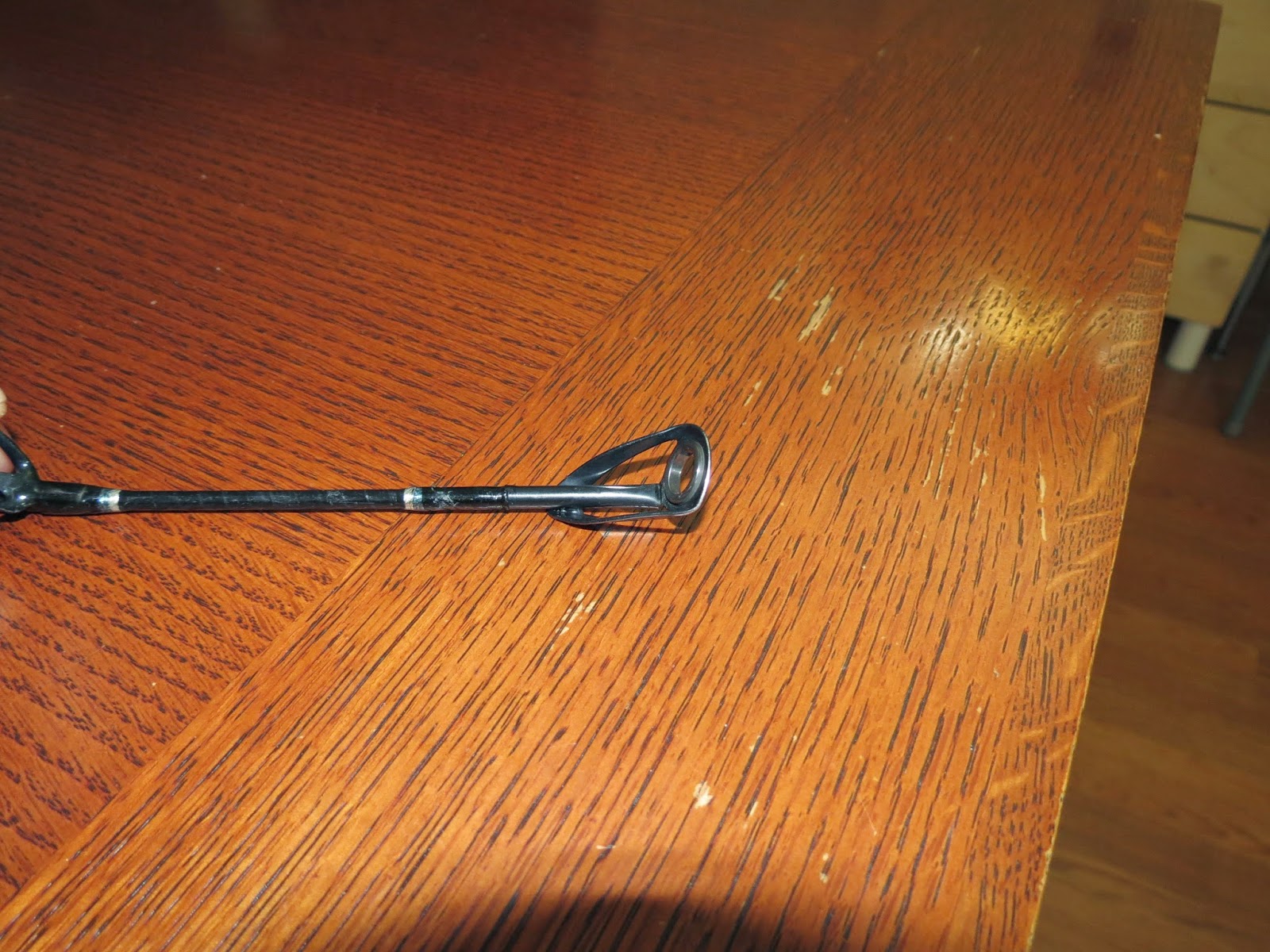
guides. Then check the guide rings (the inside circle where the line runs) for damage such as cracks, grooves, or nicks in the coating that can damage or cut your fishing line. I like to use a cotton swab and run it around the guide rings to see if the cotton snags on anything. Any defect that the cotton snags on can potentially damage your line causing it to fail at the wrong time. Many of these defects can be removed with a light sanding with a fine sandpaper or steel wool, just don't over do it. As you inspect the guides check the guide wraps and finish on the rod for signs of damage such as frayed or loose threads and cracks in the finish coat.
Undamaged guide frame and wraps

Undamaged guide ring

Crushed guide frame in need of repair

Tip top repairs are fairly simple. Fuji and other companies sale repair kits that come with an assortment of tip sizes and tip top adhesive. If the old tip top is loose but still attached using some heat from a heat gun or hair dryer to soften it enough to remove the old top. Do not use direct flame or hold a heat gun in one spot for too long as you can damage the rod. Once the old tip top is removed, clean the tip of the rod as best as you can and install the new tip top per the kits instructions. For other repairs such as broken or loose guides, broken or loose reel seats, or loose grips you may need to take the rod to a rod builder for repair or scour YouTube for "How-to's" on repairing it yourself.
Undamaged tip top

Rod tip with the tip top removed


Taking care of your equipment doesn't take a lot of time and will help to ensure you don't lose that next personal best fish due to lack of maintenance. Now its time for me to go tackle that reel. 

Before the season closes, get out there and fish! 

Cheers, Tebbs


Saturday, November 22, 2014

We've got Wheeleez Carts!

I'm very excited that we are now offering Wheeleez carts and accessories in our EBKF store! These carts are solid, well built and will get your kayak just about anywhere you need to take it. They are great in soft sand, rough terrain, mud, and they fold up to be easily stowed on the kayak. If you need a new cart these are worth taking a look at. We have a couple of different styles in the store but we can get whatever you need. SUP carts, jet ski carts, accessories, just let us know what you are looking for. Thanks, have a great day!


 Beach wheels are great not only in the sand but also on rough or muddy ground.


 Flat-free, maintenance free, "Tuff-Tire", foam wheels.


The beach cart in the folded position. Made with a strong but light aluminum frame and stainless steel hardware.


Saturday, November 8, 2014

1st Annual Estero Kayak Challenge

Hey, check it out!

Estero Bay Kayak Fishing 
is hosting a tournament!
Announcing the 

The Estero Kayak Challenge is paying out cash to the top winners in each division, along with great prizes and an incredible raffle benefitting
 Heroes on the Water.

We already have some awesome sponsors on board for the event with more to come. Check out the event sponsors page for a list of our wonderful supporters! 

For information and to register, go to the links on the Estero Bay Kayak Fishing site or click on the octopus above!

We hope to see you at the Estero Kayak Challenge!


Tuesday, November 4, 2014

Wilderness Systems Thresher 140

Super stoked! Received the new Wilderness Systems Thresher 140 yesterday. Been waiting for a while as they worked out some production issues to get things right. Well my initial impression is WOW! I have to admit it's a lot of boat at 14 feet. I've never had a kayak this long but, the layout, the features, and the overall design are very nice. You can tell that they put a lot of effort into the design and features they integrated. Here are some pics:

 Thresher 140 in dusk color.

 Front hatch, hinged in the front with good quality closures in the rear.

 Enclosed front hatch, offers some great front storage. There are scupper holes in place but the Thresher comes with plugs to keep the area dry.

 The Thresher's cockpit is roomy and well laid out. The new foot braces are large and comfortable.

The large center hatch is equipped with a rubber gasket and locking mechanisms to hold it tightly in place. It is also hinged in the front for easy opening and closing. The center hatch is able to accommodate fishing rods for launching and landing in the surf.

I love the removable pod on the Ride 115X but the pod on the Thresher is a big improvement in design. It is large and roomy but not overly bulky. Like the center hatch it is held in place by some solid clamps.

A shot of the pod removed. You can see the large opening for multiple sizes of transducers.

I got mine with the optional rudder kit. I think the rudder will be a nice addition on this 14 foot kayak.

This is the rudder deployment system for lifting and lowering the rudder from the seat. The rudder itself is operated by the foot braces.

The rear tankwell is really large and comes with a bungee system along with 2 tie down straps. You can see there is also a spot to install a round hatch should you choose.

The seat of the Thresher is the original Air Pro seat. A comfortable seat with some adjustability to it. 

There's a quick overview of the Thresher. Soon, I'll do a more in depth review, after I get it out on the water. Thanks for checking it out!